How DDoS Attacks Actually Work Behind the Scenes
DDoS attacks are engineered systems, not random traffic spikes. Understand botnet orchestration, attack layers, and modern mitigation strategies for resilient web platforms.
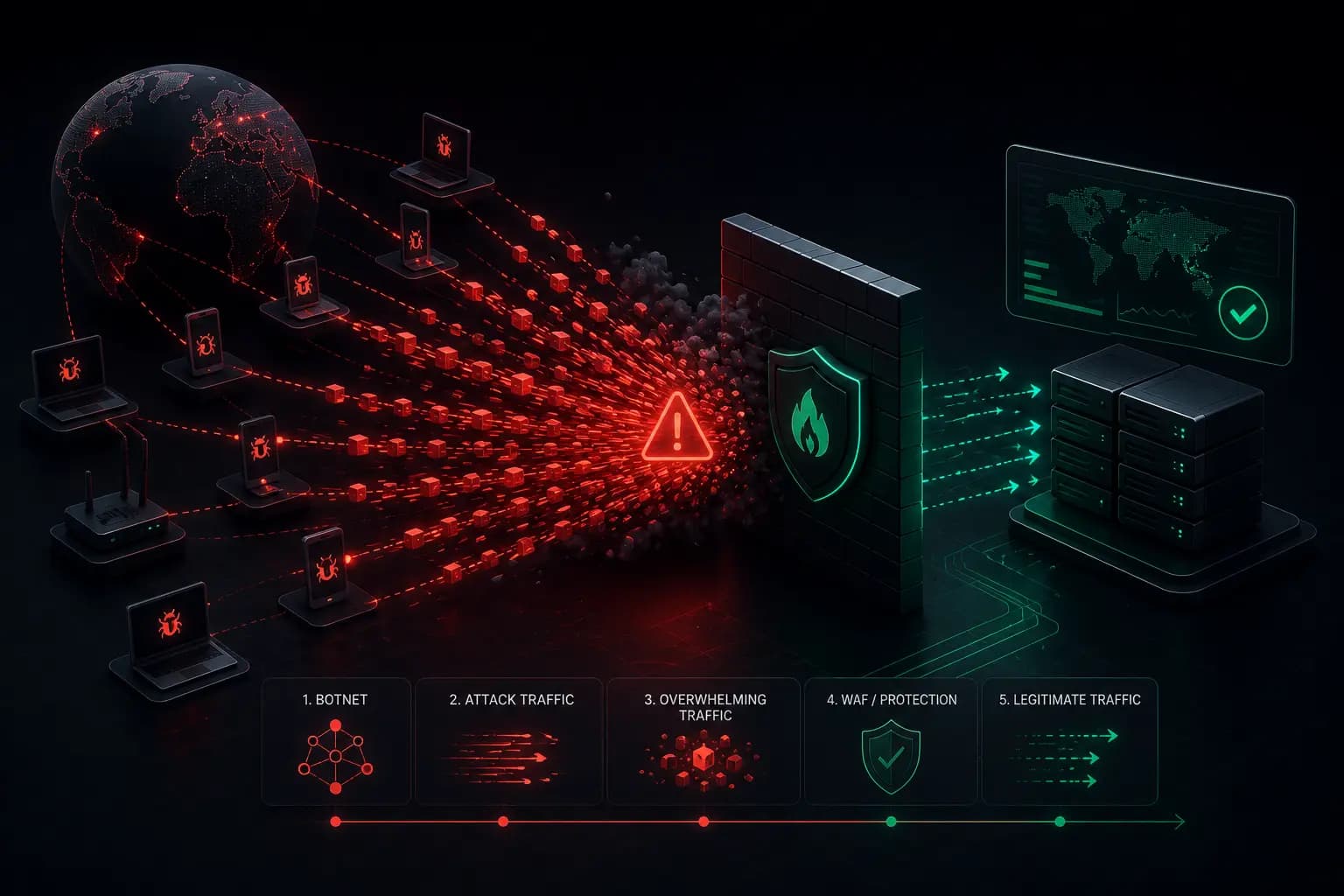
When people hear "DDoS attack," they usually imagine one thing: huge traffic floods.
That is only part of the story.
Modern DDoS operations are coordinated systems with target selection, reconnaissance, attack-layer choice, and adaptive tactics based on defender behavior. Understanding the mechanics behind the scenes helps teams design controls that fail gracefully instead of collapsing under pressure.
Quick Refresher: What DDoS Means
Distributed Denial of Service (DDoS) is an attempt to reduce service availability by overwhelming a target with malicious traffic or resource exhaustion patterns from many distributed sources.
Key properties:
- Distributed: traffic comes from many hosts, often across regions
- Denial: objective is unavailability, latency, or degraded experience
- Service-level impact: not always full outage; partial disruption still causes losses
The Attacker Pipeline Behind a DDoS Campaign
Large attacks are typically not improvised.
1) Botnet Assembly
Attackers build or rent traffic sources using:
- Compromised IoT devices
- Malware-infected consumer endpoints
- Abused cloud instances
- Proxy networks
Botnets may include command-and-control infrastructure that can switch attack vectors quickly.
2) Reconnaissance
Before launching, attackers assess:
- DNS and CDN footprint
- Origin IP exposure
- Caching behavior
- Expensive endpoints (search, login, checkout, report generation)
- Upstream bandwidth assumptions
This reconnaissance determines whether to use volumetric floods, application-layer abuse, or multi-vector blending.
3) Traffic Orchestration
Attack commands specify:
- Target host/path
- Request method and headers
- Concurrency and ramp profile
- Rotation strategy for IPs and user agents
Some campaigns intentionally mimic normal browser behavior to bypass simplistic filters.
4) Adaptive Escalation
If defenders block one vector, attackers shift:
- UDP flood -> SYN flood
- Raw flood -> HTTP request flood
- Single endpoint -> multiple expensive routes
Effective DDoS defense expects this adaptation and plans layered controls accordingly.
Main DDoS Categories and How They Work
Volumetric Attacks (Layer 3/4)
Goal: saturate network links or edge capacity.
Common types:
- UDP floods
- Amplification attacks (DNS, NTP, CLDAP patterns)
- GRE floods
Defensive priority: absorb and filter at edge before traffic reaches origin.
Protocol Attacks
Goal: exhaust connection/state resources on networking devices or servers.
Examples:
- SYN floods
- ACK floods
- Fragmentation abuse
Defensive priority: connection handling hardening, SYN cookies, and upstream scrubbing.
Application-Layer Attacks (Layer 7)
Goal: exhaust CPU, memory, or backend dependencies with "valid" HTTP traffic.
Common patterns:
- High-rate requests to expensive dynamic endpoints
- Cache-busting query variants
- Search and report endpoint abuse
- Login endpoint flood with realistic timing
Defensive priority: behavioral filtering, rate limits, route-specific controls, and caching strategy.
Why Layer 7 DDoS Is Often Harder
Volumetric attacks are noisy and easier to classify quickly. Layer 7 floods can resemble real users:
- Valid TLS handshakes
- Legitimate paths
- Human-like request timing
- Rotating fingerprints
This is where WAF, bot management, and application-aware rate control become critical.
Related reading: What is a web application firewall and why it matters.
Anatomy of a Realistic Layer 7 Campaign
A typical sequence:
- Botnet sends low-rate probe traffic to profile protection behavior.
- Attack focuses on uncached endpoint (
/api/report/export). - Requests include unique query params to bypass CDN cache.
- Backend queue depth rises; DB CPU hits saturation.
- Attacker adds secondary flood to login route to distract responders.
User impact:
- API timeouts increase
- Checkout latency spikes
- Intermittent 5xx errors
- Support volume surges
This may not look like a "classic outage," but business impact can be severe.
Defensive Architecture That Holds Under Pressure
There is no single magic control. Effective mitigation is layered.
Edge and CDN Protection
- Anycast distribution to absorb global load
- Automated DDoS scrubbing at edge
- Origin shielding to reduce direct pressure
WAF and Bot Controls
- Signature and anomaly-based filtering
- JavaScript/browser integrity checks for suspicious traffic
- Challenge-response for high-risk request cohorts
Rate Limiting and Resource Governance
- Per-route and per-identity quotas
- Concurrency caps on expensive operations
- Circuit breakers for vulnerable dependencies
Application Resilience
- Aggressive caching where safe
- Queue backpressure controls
- Graceful degradation modes (read-only fallbacks, deferred jobs)
DDoS Runbook: What to Do During an Attack
Preparation matters more than heroic response.
Recommended runbook structure:
| Step | Owner | Action | Success Signal |
|---|---|---|---|
| Detect | SRE/SOC | Confirm attack type and affected layers | Attack classified within minutes |
| Contain | Edge platform | Enable mitigation profile, tighten WAF/rate limits | Error rate stabilizes |
| Protect core paths | App team | Prioritize auth, checkout, and key APIs | Business-critical flows remain available |
| Communicate | Incident lead | Internal and customer updates | Clear status cadence |
| Recover | Engineering | Roll back temporary strict rules gradually | No immediate re-surge |
Teams that predefine this flow recover faster and make fewer risky changes under stress.
Attack Economics: Why DDoS Persists
DDoS remains attractive because:
- Launch cost is low (booter markets and rented botnets)
- Attribution is difficult
- Even short disruptions can cause business loss
- Multi-vector attacks force defender context switches
Defenders win by increasing attacker cost and reducing achievable impact window.
Common Mistakes During Mitigation
- Blocking entire geographies without business impact analysis
- Applying global rate limits that lock out legitimate users
- Ignoring origin hardening because CDN is in front
- Disabling logging to reduce load (losing incident visibility)
- Keeping emergency rules forever (policy debt)
Fast response should still be disciplined response.
Capacity Planning for DDoS Resilience
Resilience requires both security controls and engineering choices.
Planning checklist:
- Baseline normal and peak traffic by route
- Define hard limits for critical dependencies
- Load test with adversarial patterns, not only happy-path load
- Document fail-open/fail-closed decisions per component
- Test incident comms and on-call escalation paths quarterly
For smaller teams, pair this with /blog/top-10-website-security-mistakes-small-businesses-make.
Signals to Monitor in Real Time
During active events, watch:
- Requests per second by path and status
- Cache hit ratio changes
- Origin connection saturation
- Queue depth and worker latency
- Authentication failure bursts
- Error budgets burning by service
Good telemetry helps distinguish true attack pressure from cascading internal failures.
Post-Incident Review: Where Teams Improve Fastest
The most valuable DDoS work happens after traffic normalizes.
Strong post-incident reviews answer specific questions:
- Which controls reduced impact measurably?
- Which mitigation steps arrived too late?
- Which emergency rules introduced customer friction?
- Which internal dependencies failed before edge protections?
Turn findings into owned actions with deadlines. Typical backlog items include route-level cache adjustments, stricter origin ACLs, tuning challenge thresholds, and clearer communication templates for status updates.
If your review ends as a narrative without engineering follow-through, resilience will not improve before the next campaign.
FAQ
Are DDoS attacks always massive bandwidth floods?
No. Many effective attacks are application-layer campaigns that target expensive endpoints and backend bottlenecks with moderate traffic.
Can a CDN alone stop all DDoS attacks?
A CDN is foundational but not sufficient by itself. You also need WAF policy, bot controls, origin protection, and application-level resilience patterns.
How long do DDoS attacks usually last?
Duration varies from minutes to days, often with waves and vector shifts. Prepared teams can maintain partial service even during prolonged events.
What is the most important control for Layer 7 DDoS?
Route-specific rate limiting combined with bot mitigation and caching strategy is often the highest-impact starting point.
Should small businesses plan for DDoS response?
Yes. Even moderate disruptions can hurt revenue and trust. Basic runbooks and managed edge protection provide meaningful resilience.
Conclusion
DDoS attacks work because they exploit both technical bottlenecks and operational chaos.
The best defense is not a single appliance. It is a layered system: edge absorption, application-aware filtering, resource governance, and practiced incident operations.
If your team understands the mechanics behind the scenes, mitigation decisions become faster, safer, and more effective when pressure is highest.