What Is a Web Application Firewall (WAF) and Why It Matters
A practical guide to Web Application Firewalls: how WAFs inspect HTTP traffic, what threats they stop, where they fall short, and how to deploy policies without breaking product velocity.
Ask ten teams why they deployed a WAF and you will hear two answers:
- "Compliance needed it."
- "We were getting attacked."
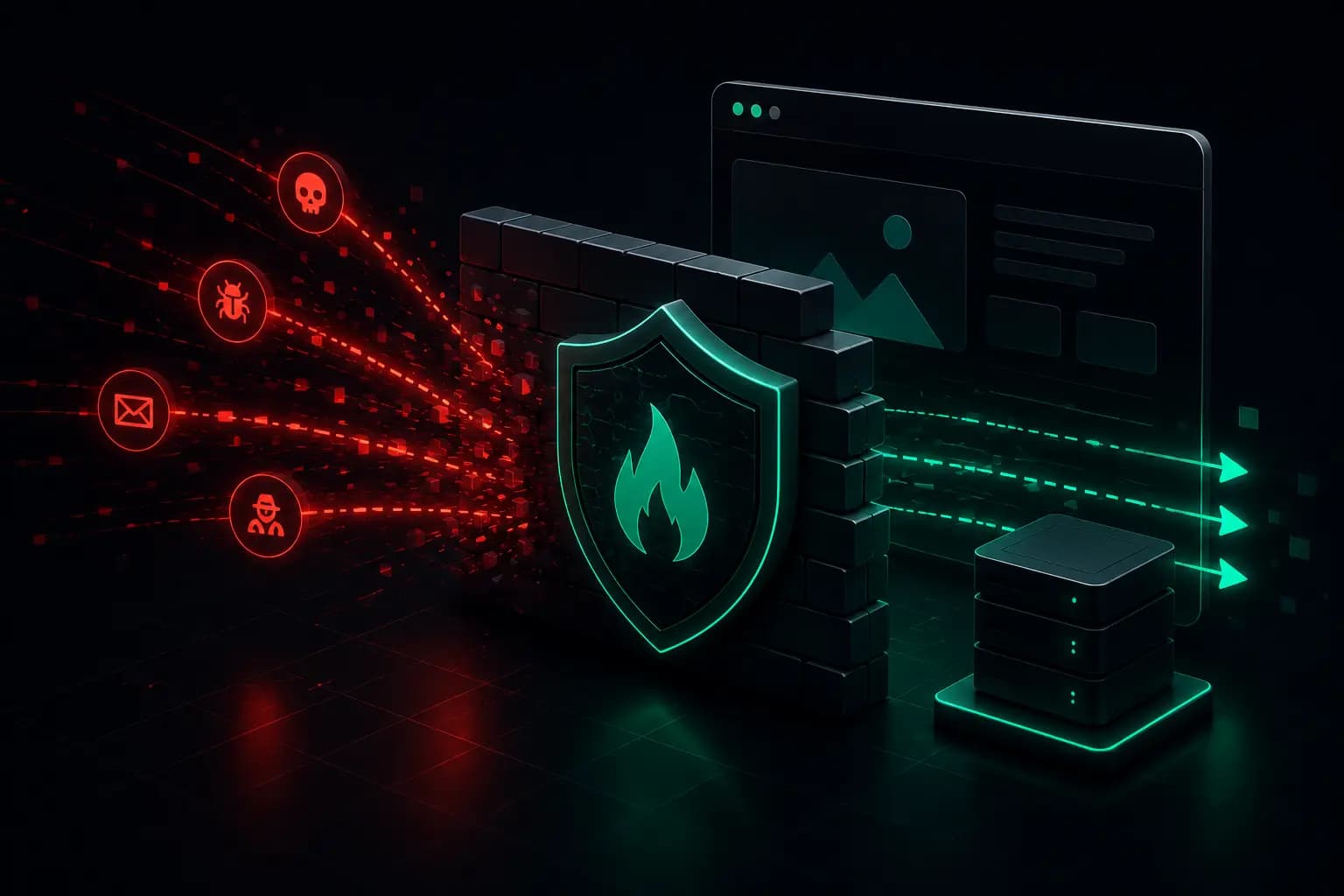
Both can be true, but neither explains how to run a WAF effectively. A Web Application Firewall is not just a checkbox or an emergency switch. It is a programmable control layer for HTTP traffic that sits between users and your application.
Used well, it reduces exploit volume, buys patching time, and improves attack visibility. Used poorly, it creates false confidence and brittle rule sets.
What a WAF Actually Does
A WAF inspects web requests and responses at layer 7. Instead of only checking IP and ports, it evaluates:
- Request methods and paths
- Headers and cookies
- Query parameters and body content
- Client behavior patterns
- Protocol anomalies
Based on policy, it can allow, block, challenge, or rate-limit traffic.
Why WAFs Matter More in 2026
Modern applications expose broad HTTP attack surface:
- Public APIs for web and mobile clients
- Third-party webhooks
- Admin and partner portals
- Edge-rendered front ends with dynamic backends
Attackers automate against this surface continuously. Waiting for secure code fixes alone leaves long windows of exposure.
A WAF provides "virtual patching" while engineering teams build permanent remediations.
Threats a WAF Is Well-Suited to Mitigate
No tool solves all categories, but WAFs are strong in several areas.
Common Injection and Payload Attacks
Rule sets can detect signatures and patterns linked to:
- SQL injection
- Cross-site scripting probes
- Command injection attempts
- Path traversal payloads
Bot and Credential Abuse
Behavioral controls help with:
- Credential stuffing
- Brute-force login attempts
- Automated scraping
- Inventory hoarding bots
Protocol and Request Anomalies
WAFs can block malformed or suspicious traffic such as:
- Invalid method/path combinations
- Header smuggling indicators
- Oversized payload abuse
- Abnormal content-type mismatches
What a WAF Does Not Replace
A WAF is not a substitute for:
- Secure software design
- Authorization checks
- Dependency patching
- Identity governance
If an attacker uses valid credentials to abuse business logic, a generic WAF policy may not catch it. That is why WAF should be layered with application telemetry and identity-aware controls.
Related context: /blog/why-traditional-firewalls-fail-against-modern-web-attacks.
Deployment Models: Edge, Cloud, or Self-Managed
There is no universal best model. Choose based on team capabilities and latency constraints.
| Model | Strengths | Trade-Offs | Best Fit |
|---|---|---|---|
| Managed edge WAF | Fast rollout, global coverage, bot intelligence | Vendor coupling, policy abstraction limits | Most SaaS teams |
| Cloud-native WAF | Tight cloud integration, IAM alignment | Cloud-specific complexity | Single-cloud platforms |
| Self-managed WAF | Maximum customization | High operational burden | Specialized environments |
For most growth-stage companies, managed edge WAF gives the best security-to-operations ratio.
Policy Design: Start Narrow, Then Expand
A common failure is enabling broad blocking rules on day one.
Safer rollout pattern:
- Monitor mode on critical routes
- Baseline legitimate traffic behavior
- Enable blocking for high-confidence signatures
- Add route-specific policies for login, checkout, and API endpoints
- Review false positives weekly
This protects users while preserving release velocity.
Practical Rule Categories to Implement Early
Prioritize controls with high impact and low business risk.
Authentication Surface
- Rate-limit login and password reset routes
- Add bot challenge on suspicious credential bursts
- Block known malicious user-agents and automation fingerprints
Input Validation at the Edge
- Enforce method restrictions by route
- Restrict unexpected content types
- Cap body size for endpoints that do not need large payloads
Abuse Controls for APIs
- Rate-limit by token, IP, and route
- Detect unusual fan-out patterns per identity
- Block schema-violating payloads where possible
Example: Route-Specific WAF Policy Logic
{
  "route": "/api/auth/login",
  "rules": [
    { "type": "rate_limit", "threshold": "20 req/5m per IP", "action": "challenge" },
    { "type": "geo_anomaly", "condition": "high_risk_country && new_device", "action": "block" },
    { "type": "payload_signature", "condition": "sqli || xss_probe", "action": "block" }
  ]
}
Notice this is route-specific, not global. Good WAF programs are contextual.
False Positives: The Main Operational Risk
Every WAF team eventually faces this incident: legitimate traffic gets blocked during a product launch.
Prevention steps:
- Define rollback criteria before enforcement
- Maintain exception lifetimes, not permanent bypasses
- Pair security and product owners during major releases
- Track false positives as reliability defects
If false positives are ignored, teams quietly disable protections and exposure grows again.
Integrating WAF Signals Into Incident Response
A WAF should feed your broader detection pipeline.
High-value integrations:
- SIEM/SOC enrichment
- Identity risk scoring
- Incident timeline correlation with app logs
- Automated ticket creation for repeated exploit probes
This turns edge events into actionable operational intelligence.
Scenario: Virtual Patching During a Critical CVE
A framework CVE is disclosed. Your app is vulnerable. Patch requires testing and cannot ship safely in two hours.
WAF response:
- Deploy temporary block rule for exploit signature and route patterns.
- Monitor attempted exploitation volume and source profiles.
- Keep temporary rule until app patch reaches production.
- Remove temporary rule after validation to reduce policy debt.
Without WAF, your only immediate option is risky emergency deploys or hoping you are not targeted first.
WAF Metrics That Actually Matter
Avoid vanity metrics like "number of rules enabled."
Track:
- Blocked exploit attempts by class and route
- False-positive rate by endpoint
- Time to deploy virtual patch after CVE disclosure
- Credential abuse suppression on auth routes
- Incident reduction attributable to edge controls
These connect WAF operations to measurable risk reduction.
Change Management for WAF Policies
WAF changes should follow software-quality practices, especially in high-traffic SaaS products.
Recommended process:
- Define policy-as-code with version control
- Peer review rule changes before enforcement
- Test against representative traffic samples
- Roll out progressively by route cohort
- Attach rollback instructions to every change request
This reduces surprise outages and turns WAF operations into a predictable engineering workflow instead of reactive firefighting.
Common Misconceptions
"Our framework already sanitizes input."
Framework controls help, but they do not eliminate all exploit paths or zero-day risks. Defense in depth still applies.
"WAF slows down traffic."
Modern managed WAF platforms are optimized for low-latency inspection. Poor policy design causes more issues than platform overhead.
"Once configured, it runs itself."
Threats and product behavior evolve. WAF policies require ownership, tuning, and regular review.
FAQ
Is a WAF necessary for API-only products?
Yes. API endpoints are still HTTP attack surface. WAF policies can enforce request constraints, rate limits, and exploit filtering for APIs.
Can a WAF stop zero-day attacks?
Sometimes partially, especially through anomaly blocking and generic exploit heuristics. It is not guaranteed, but it often buys response time.
How quickly can a team deploy a managed WAF?
Many teams can go live in days for baseline coverage, then spend several weeks tuning route-specific policies and automation.
Should we run WAF in blocking mode immediately?
Usually no. Start in monitor mode for critical paths, validate behavior, then enable targeted enforcement where confidence is high.
How does WAF relate to Zero Trust?
WAF secures web traffic at the edge, while Zero Trust governs identity and access decisions across systems. They are complementary, not competing models.
Conclusion
A WAF matters because modern attacks target application behavior, not just network boundaries.
The strongest outcomes come from disciplined implementation: route-aware policies, gradual enforcement, and tight integration with detection and response workflows.
Deploy it as an active security layer, not a passive compliance artifact. When tuned well, a WAF materially lowers exploit exposure and gives engineering teams the time they need to patch responsibly.