Why Traditional Firewalls Fail Against Modern Web Attacks
Packet filters still block noisy network abuse, but modern web attacks ride over trusted ports and valid HTTP. Learn where legacy firewalls break down and how to build layered web defense.
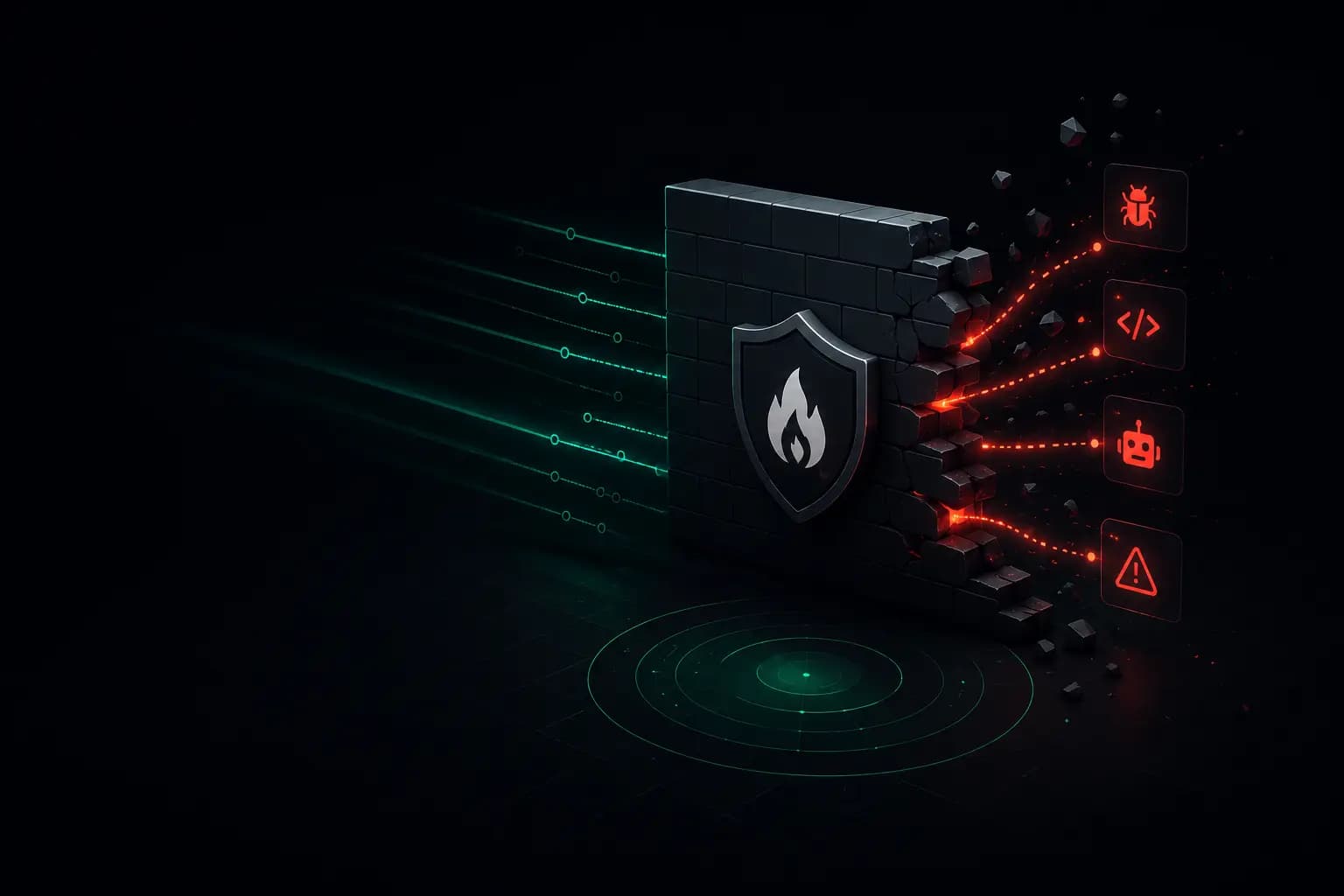
Traditional firewalls are still useful. They reduce exposure, enforce segmentation, and block obvious protocol misuse. But they were not designed to understand application behavior at the level modern attackers exploit.
Most teams learn this the hard way: traffic on 443 looks healthy, TLS is valid, request rates are normal, and the firewall sees nothing suspicious. Meanwhile, attackers are abusing business logic, chaining API endpoints, and extracting data through perfectly "allowed" paths.
This is not a failure of network engineering. It is a mismatch between control surface and attack surface.
What Traditional Firewalls Actually Do Well
Before criticizing legacy controls, it is worth being precise about their strengths.
Traditional firewalls are excellent at:
- Restricting ingress and egress by IP, port, and protocol
- Enforcing coarse network boundaries between environments
- Blocking known-bad IP ranges and geographies
- Preventing accidental service exposure
- Supporting compliance controls around segmentation
If your organization removed these controls tomorrow, incident volume would rise quickly.
The issue is scope. Layer 3/4 controls evaluate connection metadata, not HTTP semantics. Modern threats increasingly live in HTTP payloads, session context, and application workflows.
Why Modern Web Attacks Bypass Layer 3/4 Controls
Attackers now optimize for "normal-looking" traffic.
1) Everything Happens Over Trusted Channels
Legitimate traffic and malicious traffic both use HTTPS on port 443. A traditional firewall sees encrypted sessions and allows them based on policy. Unless traffic is decrypted and inspected deeply, malicious intent remains hidden.
Even with TLS interception, metadata-only rules still miss:
- SQL injection payloads
- GraphQL resolver abuse
- IDOR enumeration patterns
- Session fixation or token replay
2) The Attack Is in the Workflow, Not the Packet
Consider a checkout API:
POST /cart/add-itemPOST /coupon/applyPOST /checkout/submit
Each request is syntactically valid. The exploit may be sequence abuse: applying expired internal promo codes by racing two requests in parallel, then finalizing before reconciliation runs.
No packet filter can infer that this sequence is abusive. The requests are well-formed and authenticated.
3) API-First Architectures Increase Blind Spots
Single-page apps, mobile clients, and service-to-service APIs shift logic to JSON endpoints. Attackers no longer probe only classic form fields; they test nested objects, serialization edge cases, schema drift, and undocumented endpoints.
Typical examples:
- Over-posting hidden fields in JSON payloads
- Exploiting permissive deserializers
- Triggering expensive resolver paths for denial-of-wallet attacks
- Enumerating object IDs across tenants
These are application security issues, not port/protocol issues.
A Realistic Breach Pattern
Here is a common chain seen in incident response:
- Attacker authenticates using a low-privilege stolen credential.
- They inspect front-end JavaScript and identify internal API routes.
- They discover weak authorization checks on
GET /api/invoices/:id. - They automate ID enumeration across predictable invoice IDs.
- They exfiltrate financial records slowly to avoid rate spikes.
From the firewall's perspective:
- Source IP may be residential and not reputation-listed.
- Requests are over HTTPS.
- Packet size and rates appear normal.
- No prohibited port or protocol is used.
This is why post-incident reports often include lines like "network controls were operating as expected."
Where Teams Overestimate Legacy Coverage
Security teams rarely assume firewalls solve everything. The bigger issue is organizational misunderstanding:
- Product teams think "protected by firewall" means "protected from web attacks."
- Leadership sees low perimeter alerts and infers low application risk.
- Compliance checklists reward control presence, not control effectiveness.
This creates a dangerous confidence gap.
A passed network security audit does not prove resilient application security.
The Modern Control Stack That Closes the Gap
Traditional firewalls should remain in your architecture. The fix is adding controls that understand requests, identities, and behavior.
Web Application Firewall (WAF)
A WAF inspects HTTP-layer signals such as headers, query strings, request bodies, cookies, and bot fingerprints. Managed WAFs combine static rules with anomaly detection and rapid signature updates.
WAFs are especially effective for:
- OWASP Top 10 style payload attacks
- Known exploit probes during zero-day windows
- Bot mitigation and credential stuffing resistance
For a deeper dive, see our guide: /blog/what-is-a-web-application-firewall-and-why-it-matters.
API Security Controls
API gateways and API-focused security layers should enforce:
- Schema validation
- AuthN and fine-grained AuthZ
- Abuse detection per identity, token, and route
- Sensitive field redaction in logs
If your architecture is API-first, treating API security as optional is equivalent to leaving your primary attack surface under-defended.
Runtime Detection and Telemetry Correlation
Effective detection blends:
- CDN and edge logs
- WAF events
- Application logs
- Identity provider events
- Database audit trails
Correlated signals catch low-and-slow attacks that single controls miss.
Security Testing in CI/CD
Preventive controls reduce incident load:
- SAST for code-level anti-patterns
- DAST against staging with realistic auth flows
- IaC scanning for accidental exposures
- Contract testing for authorization boundaries
Practical Migration Strategy (Without a Rewrite)
Most teams cannot replace controls in one quarter. A staged approach works better.
| Phase | Timeline | Objective | Typical Output |
|---|---|---|---|
| Baseline | 2-3 weeks | Map exposure and top abuse paths | Endpoint inventory, attack path register |
| Shield | 2-4 weeks | Deploy managed WAF in monitor mode, then enforce | Route-level policies, false-positive tuning |
| Harden | 4-8 weeks | Add API schema and authz guardrails | Contract checks, token/rate policies |
| Detect | Ongoing | Correlate telemetry and improve response | Alert runbooks, threat hunting queries |
This approach avoids two common failures: rushing enforcement without tuning, and endless assessment with no production controls.
A Nuanced View: Firewalls Are Not Obsolete
It is tempting to frame this as old versus new. That misses how resilient systems are actually built.
Traditional firewalls still matter for:
- Segmentation and blast-radius reduction
- Restricting lateral movement
- Enforcing outbound controls for compromised workloads
- Governance where cloud-native controls vary by team
But they are one layer. If your only web defense is a layer that cannot reason about web behavior, you are overexposed by design.
Operational Signals You Should Track
To measure whether your posture is improving, track outcomes, not only control deployment.
Recommended metrics:
- Mean time to detect suspicious API abuse
- Percent of internet-facing endpoints with explicit authz tests
- WAF false-positive rate after policy tuning
- Block rate for known exploit payload classes
- Time from CVE disclosure to effective virtual patch
These indicators are harder to game than "tool installed" metrics and align better with real risk reduction.
Common Objections (And Better Responses)
"We already terminate TLS at the load balancer."
Good, but TLS termination is visibility plumbing, not security logic. You still need request-level inspection and application-aware policies.
"Our APIs require authentication."
Authenticated abuse is still abuse. Broken object-level authorization, token replay, and privilege confusion are all authenticated attack patterns.
"False positives will break product velocity."
They can, if you enforce too early. Start in monitor mode, tune high-risk routes first, and deploy changes behind clear rollback conditions.
FAQ
Are traditional firewalls still required in cloud-native environments?
Yes. They remain foundational for segmentation, egress control, and reducing exposure. They are necessary but not sufficient for web threat defense.
Can a WAF replace secure coding?
No. A WAF buys time and blocks common exploit traffic, but logic flaws, authorization bugs, and insecure design still require engineering fixes.
What is the biggest blind spot in firewall-only architectures?
Application-layer abuse that appears as valid HTTPS traffic: API misuse, business logic exploitation, and low-rate authenticated exfiltration.
Is this mainly an enterprise problem?
No. Small and mid-sized companies are frequent targets because they often have exposed SaaS apps with lighter security staffing and fewer layered controls.
How quickly should teams add web-layer controls after launching a product?
Immediately for public endpoints. At minimum, use a managed WAF and route-level telemetry before significant customer growth or marketing launches.
Conclusion
Traditional firewalls fail against modern web attacks for one simple reason: they are inspecting the wrong layer for today’s dominant threat patterns.
Keep them. But stop expecting packet-level controls to catch application-layer abuse.
The practical path is layered defense: perimeter controls, web-layer inspection, API-specific protections, and telemetry correlation tied to fast response playbooks. Teams that make this shift do not eliminate incidents, but they detect abuse sooner, reduce impact, and recover with much higher confidence.