How AI Is Changing Modern Threat Detection
AI is accelerating threat detection across logs, identities, and network telemetry, but it also introduces drift, blind spots, and operational risk. What actually works in 2026.
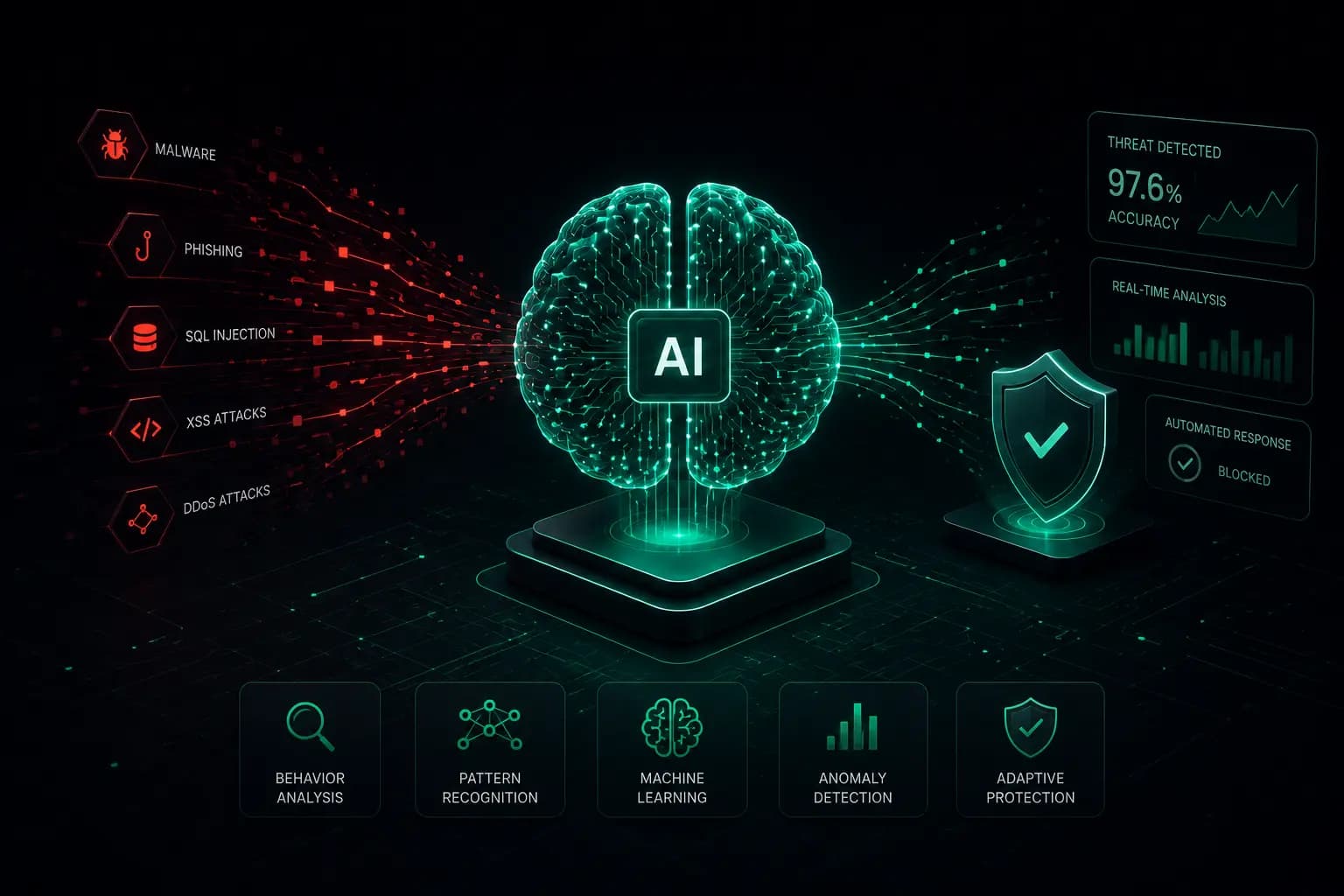
Security teams have used machine learning for years, but 2026 feels different.
The change is not that AI suddenly "solves detection." The change is operational: analysts now use AI-assisted triage, detection engineering pipelines rely on model-generated hypotheses, and SOC workflows increasingly blend deterministic rules with probabilistic ranking.
This creates both leverage and new failure modes.
What Changed in the Last Two Years
Three shifts made AI materially more useful in detection programs:
- Better cross-domain correlation between identity, endpoint, cloud, and application telemetry.
- Faster analyst interaction through natural-language investigation interfaces.
- Practical retrieval pipelines that ground model outputs in local security data.
The result is less time spent manually stitching context and more time validating whether a sequence is malicious.
Where AI Delivers Real Value Today
Not every SOC use case benefits equally. The strongest returns usually appear in high-volume, context-heavy workflows.
Alert Triage and Prioritization
AI models can rank alerts using historical incident outcomes, entity criticality, and behavior patterns.
Instead of triaging 1,200 medium-severity alerts flatly, analysts can focus first on the 40 with strongest attack-path potential.
High-value signals for ranking:
- Privilege level of affected identities
- Exposure of touched assets
- Historical frequency of similar events
- Kill-chain progression indicators
This does not replace detection logic; it improves analyst attention allocation.
Behavioral Baselines and Anomaly Detection
Traditional threshold rules miss subtle deviations. AI models can capture:
- Typical login geographies per user cohort
- Normal service-to-service call patterns
- Usual data access volumes by role and time window
When deviations align across dimensions, confidence increases.
Example:
- A support account accesses finance records (unusual role-object pairing)
- Access occurs from a new ASN
- Session triggers unusual API fan-out
Any one signal might be benign; combined, they deserve rapid investigation.
Detection Content Generation
AI can accelerate first drafts for:
- Sigma-like detection rules
- KQL/SPL query candidates
- Threat hunting hypotheses
- Playbook suggestions
But generated content should be treated like junior output: useful starting point, never blind deploy.
-- Example: seed query for suspicious token replay
SELECT user_id, token_id, COUNT(DISTINCT ip_address) AS ip_count
FROM auth_events
WHERE event_time > NOW() - INTERVAL '30 minutes'
GROUP BY user_id, token_id
HAVING COUNT(DISTINCT ip_address) > 3;
The Quiet Risk: AI Can Increase Noise Too
Many teams discover this after an enthusiastic rollout.
Common causes:
- Poorly curated training labels
- Domain drift after architecture changes
- Overweighting "rare" events that are normal in specific teams
- Weak feedback loops from analyst verdicts
If you deploy models without lifecycle management, alert fatigue can worsen.
AI in Threat Detection Needs Guardrails
The safer model is "AI-assisted detection engineering," not "AI-operated SOC."
Recommended guardrails:
- Keep high-confidence deterministic detections for known bad patterns.
- Use AI scoring as a prioritization layer, not sole disposition authority.
- Require evidence citation for model-generated investigation summaries.
- Version detection models and tie changes to measurable outcomes.
In security operations, explainability is not optional. It is part of incident accountability.
Practical Architecture Pattern for 2026
A resilient pipeline often looks like this:
- Ingest telemetry from IdP, endpoint, cloud control plane, app logs, DNS, and WAF.
- Normalize into a common event schema.
- Enrich with asset criticality, identity roles, and threat intel.
- Detect via deterministic rules and behavior models.
- Rank incidents with risk scoring model.
- Review by analyst with AI-generated context summary.
- Feedback verdicts back into model and rule tuning workflows.
This hybrid model keeps control in human hands while reducing analysis latency.
Attackers Are Using AI Too
Defensive teams should assume adversaries now use AI for:
- Faster phishing variant generation
- Better social engineering pretext quality
- Script adaptation against changing defenses
- Credential stuffing optimization
In some campaigns, attacker efficiency increased more than sophistication. That still increases incident load for defenders.
Scenario: AI Helps Catch Low-and-Slow Account Takeover
A realistic example:
- User credentials are stolen from unrelated breach data.
- Attacker logs in from a residential proxy with valid MFA bypass via session token theft.
- Activity remains low volume to avoid threshold triggers.
AI-assisted detection catches the chain by correlating:
- Session age anomaly versus baseline
- New device fingerprint with old token
- Access to atypical internal objects
- Slow but persistent privilege-probing API calls
A classic SIEM rule set may miss this because no single threshold fires strongly.
What to Measure (Beyond Model Accuracy)
Security teams often over-focus on offline precision/recall.
Operationally useful metrics include:
- Mean time to triage (MTTT) before/after AI assistance
- True positive yield in top-ranked incident bucket
- Analyst override rate of model recommendations
- Detection drift after infra or product releases
- Time from feedback to model/rule adjustment
If MTTT drops and true positive concentration improves, your investment is likely paying off.
Integrating AI With Existing Controls
AI should not displace foundational controls.
Pair detection intelligence with:
- WAF enforcement and bot controls
- Zero Trust identity policy
- Runtime application monitoring
- Secure development pipelines
Related reading:
/blog/understanding-zero-trust-architecture-in-2026/blog/what-is-a-web-application-firewall-and-why-it-matters
Mistakes to Avoid During Rollout
- Buying a "black-box AI SOC" without data governance requirements
- Letting vendors define success metrics without internal baselines
- Ignoring model retraining triggers after major product launches
- Treating false positives as analyst problem instead of engineering problem
- Failing to involve legal/privacy teams in telemetry and retention design
The strongest programs treat AI operations with the same discipline as software operations.
Building a Reliable Feedback Loop
AI detections improve only when analyst outcomes are captured with enough detail.
A minimal feedback schema should include:
- Analyst verdict (
true_positive,benign,needs_more_data) - Confidence and rationale
- Missed context sources
- Recommended control action (rule update, model feature change, suppression)
This creates a reliable bridge between operations and engineering. Without it, teams repeatedly discuss "model quality" in general terms while the same bad alerts recur.
A practical cadence:
- Daily: review false positives from highest-risk queues
- Weekly: detection engineering sync for rule/model adjustments
- Monthly: drift and performance review with platform changes
The SOC that learns fastest is often the SOC that catches the next variant first.
FAQ
Does AI replace human SOC analysts?
No. AI improves triage speed, context aggregation, and hypothesis generation. Human analysts remain essential for judgment, incident scoping, and response decisions.
What data is most important for AI-based threat detection?
Identity telemetry, endpoint events, cloud audit logs, and application security logs are usually the highest-value sources when normalized and correlated.
Are AI detections inherently less reliable than rule-based detections?
Not inherently. They serve different purposes. Deterministic rules are strong for known patterns; AI models are strong for subtle, multi-signal anomalies.
How often should models be retrained?
Retraining should follow measurable drift signals and infrastructure changes, not a fixed calendar alone. Many teams use monthly evaluation plus event-driven retraining.
Is explainability mandatory for production use?
In practice, yes. Without explainable outputs, analysts cannot validate decisions effectively and incident accountability degrades.
Conclusion
AI is changing modern threat detection by compressing time: time to correlate, time to prioritize, and time to investigate.
That advantage only holds when teams run AI with controls, feedback loops, and explicit accountability. Otherwise, you get a faster pipeline that still points in the wrong direction.
Treat AI as a force multiplier for disciplined detection engineering. Teams that do this well are not replacing analysts. They are finally giving analysts enough signal quality to stay ahead of modern attack tempo.